
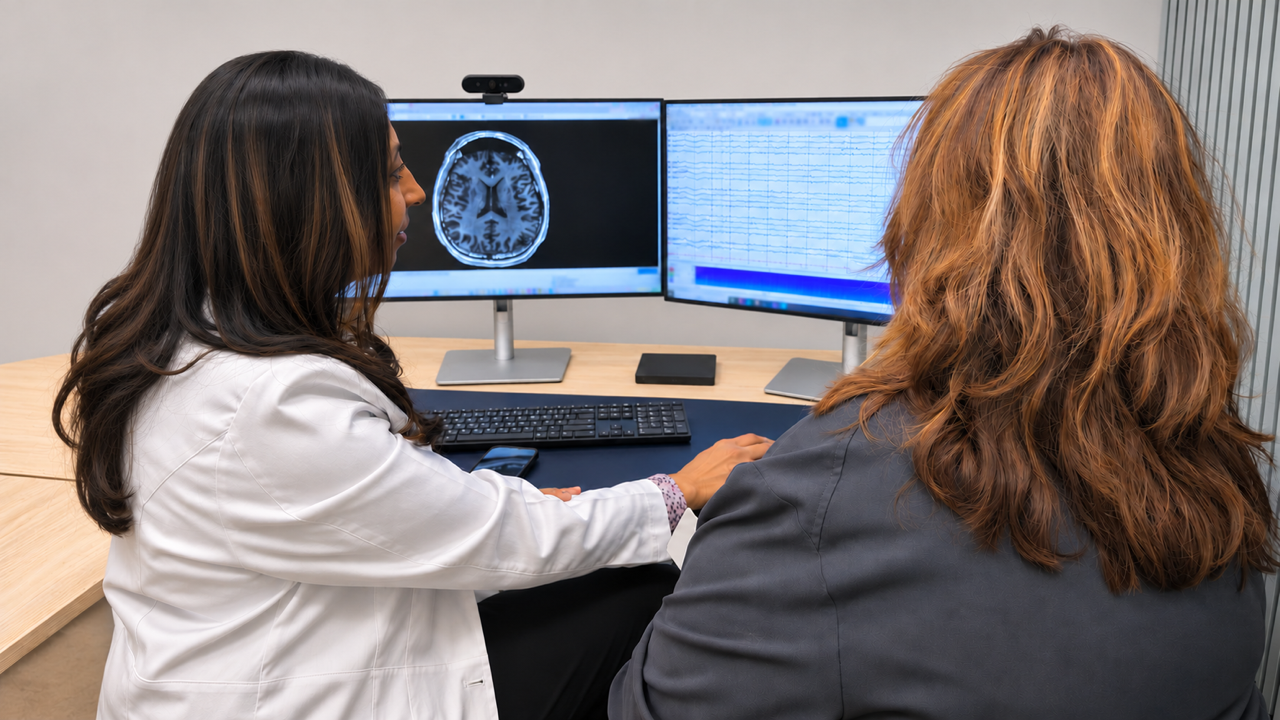
An In-Home EEG can deliver valuable insight into what's happening in your brain during everyday activities, helping neurologists better understand your symptoms and develop a customized treatment plan.
When you're having unexplained episodes of confusion, unusual sensations, staring spells, or possible seizures, finding answers can be challenging. Seizures don't always look like the dramatic convulsions people often associate with epilepsy, and some symptoms can be difficult to identify during a routine medical appointment.
That's where in-home EEG monitoring can help.
By recording your brain's electrical activity over an extended period during your daily routine, an in-home EEG gives neurologists more information to identify possible seizure activity, evaluate symptoms, and make informed treatment decisions.
What Is an Ambulatory EEG?
An in-home electroencephalogram (EEG) is a diagnostic test that continuously records your brain's electrical activity, typically for up to 72 hours.
Unlike a routine EEG, which records brain activity for up to 40 minutes, an in-home EEG captures information over a longer period, including during sleep and daily activities.
At NeuroLogic Center for Seizures & Epilepsy, we offer in-home video EEG monitoring that lets patients complete testing in the comfort of their homes.
Small electrodes placed on the scalp record brain activity, while video monitoring can document physical symptoms or behaviors during an episode. Patients can also use an event button and keep a symptom diary to help their neurologist link what they're experiencing to their recorded brain activity.
What Do Neurologists Look for in Ambulatory EEG Results?
An in-home EEG produces hours of brain activity recordings. Neurologists carefully review these results for patterns and changes that may clue them into what's causing a patient's symptoms.
Abnormal Electrical Activity That May Suggest Epilepsy
One of the primary goals of EEG monitoring is to identify abnormal electrical patterns associated with an increased likelihood of seizures.
Neurologists look for epileptiform discharges, which may include spikes or sharp waves. These patterns can provide important evidence supporting a diagnosis of epilepsy.
However, abnormal EEG findings do not automatically mean someone has epilepsy. Neurologists interpret these results alongside the patient's symptoms, medical history, and other diagnostic information.Seizure Activity That Occurs During Daily Life
Some seizures occur infrequently or without obvious physical symptoms, making them hard to capture during a short routine EEG.
Extended in-home monitoring increases the chance of recording an event as it happens. If a seizure occurs during monitoring, the EEG may help a neurologist determine:
∙Whether the episode involves abnormal electrical activity in the brain
∙Whether the seizure appears to begin in a specific region or involves broader brain networks
∙How the electrical activity changes during the event
∙Whether similar episodes share consistent patterns
This information can be especially helpful when distinguishing between different seizure types.Changes in Brain Activity During Sleep
Sleep can reveal abnormal electrical activity that may not appear while someone is awake. Because in-home EEG monitoring includes overnight recording, neurologists can evaluate brain activity during sleep and wakefulness.
This may be especially useful for patients who experience nighttime episodes, unexplained awakenings, or symptoms that occur primarily during sleep.Connections Between Symptoms and Brain Activity
Not every episode of dizziness, confusion, shaking, or altered awareness is caused by an epileptic seizure. In-home video EEG monitoring helps neurologists determine whether these symptoms are associated with abnormal electrical activity in the brain.
When a patient experiences symptoms during monitoring, they can press an event button to mark the episode. Their neurologist can then review the EEG recording and video footage from that time to look for signs of seizure activity.
This information helps neurologists better understand what's causing the symptoms and whether additional testing or treatment may be needed. However, not all seizures produce changes that can be detected by an EEG, so normal results do not necessarily rule out epilepsy.
How Ambulatory EEG Results Help Guide Seizure Treatment
An in-home EEG does more than help neurologists investigate possible seizures. Its information may also influence treatment recommendations.
Confirming or Clarifying a Diagnosis
A fuller understanding of a patient's symptoms and brain activity helps neurologists determine whether epilepsy is likely and if additional testing is needed. For patients with unexplained episodes lasting months or years, this information may clarify the next steps in their care.
Selecting an Appropriate Medication
Different seizure types may respond differently to antiseizure medications. When EEG findings identify the type of seizures a patient has, neurologists use that information and other clinical factors to select appropriate treatment. The goal is to achieve effective seizure control while minimizing medication side effects.
Evaluating How Well Treatment Is Working
For patients already receiving epilepsy treatment, in-home EEG monitoring may provide additional information about ongoing seizure activity. For example, a patient may report fewer noticeable episodes but still experience subtle symptoms that need further evaluation. Neurologists may use EEG findings with symptom reports and seizure logs to decide if treatment adjustments or more monitoring are needed.
Determining Whether Additional Testing Is Needed
Sometimes in-home EEG results provide clear answers. Other times, findings suggest further evaluation may be beneficial. Depending on the patient's symptoms and medical history, a neurologist may recommend additional testing, such as brain MRI, inpatient video EEG monitoring, or other specialized evaluations.
What Happens After Your Ambulatory EEG?
After monitoring, your neurologist reviews the recorded brain activity, symptom log, event markers, and available video footage.
At your follow-up appointment, your neurologist explains the findings and discusses what they mean for your care. Depending on the results, next steps may include:
Confirming or refining a diagnosis
Starting or adjusting antiseizure medication
Continuing to monitor symptoms
Recommending additional diagnostic testing
Discussing lifestyle considerations and seizure safety
A normal in-home EEG does not necessarily rule out epilepsy. Seizures may not occur during the recording period, and scalp electrodes may make some seizure activity difficult to detect. EEG results are only one part of a comprehensive neurological evaluation.
When Should You Consider In-Home EEG Monitoring?
Your neurologist may recommend in-home EEG testing if you experience:
Unexplained staring spells or periods of unresponsiveness
Recurring episodes of confusion or memory gaps
Sudden, unusual sensations or movements
Possible seizures that were not captured during a routine EEG
Unexplained nighttime episodes
Breakthrough seizures or changes in established seizure patterns
If you have recurring symptoms that could relate to seizures, a neurological evaluation can determine if in-home EEG monitoring is appropriate.
Get Answers With NeuroLogic Center for Seizures & Epilepsy
At NeuroLogic Center for Seizures & Epilepsy in East Providence, Rhode Island, we understand how unsettling unexplained neurological symptoms can be.
Led by Dr. Preeti Gupta, our practice provides personalized evaluation and treatment for patients experiencing seizures, epilepsy, and other neurological concerns.
Our in-home in-home video EEG monitoring lets patients complete extended testing in a familiar environment while capturing valuable information about brain activity and symptoms. From your initial evaluation through diagnosis and treatment, we aim to help you better understand your condition and move forward with confidence.
Experiencing unexplained episodes or concerned about possible seizures?
Call 401-526-0100 to schedule an evaluation and learn whether in-home EEG monitoring may be right for you.
